

July Announcements
July Announcements
From the Director
July 31, 2026
Michael Wilcox named Assistant Extension Director for Health and Human Sciences and Community Development
Since stepping down as assistant dean of the College of Health and Human Sciences and program leader of HHS Extension, I have been extremely grateful to my colleague Lisa Graves, who has done an incredible job serving as interim program leader. In recent months Lisa shared with me that she would like to return to her previous role as assistant program leaders once a HHS program leader was selected. Thank you again to Lisa for all she accomplished in this interim role!
In consultation with HHS Dean Aaron Bowman, I have decided to combine two positions and appoint Michael Wilcox as Assistant Extension Director and Program Leader for Health and Human Sciences and Community Development. In this new position, Michael and his colleagues will advance Purdue Extension’s missions by aligning research-based education, engagement and applied scholarship across the program areas. The teams will work individually and together toward the goals of strengthening community resilience, economic opportunity and individual and family well-being.
Michael, who is also the associate director of the North Central Regional Center for Rural Development, earned his doctorate in agricultural economics at Purdue, and returned to campus in 2012 to work in Extension Community Development, the Center for Regional Development and as the regional economics specialist in the Department of Agricultural Economics.
Congratulations and thank you to Michael for assuming this role and to both teams for their continued commitment.
Angie Abbott
Associate Dean and Director of Purdue Extension
Transformation Teams Update
Extension’s Transformation continues to move forward in the East Central and West Central Regions. We will provide monthly updates to share the strategies regional field offices are testing as we navigate this transition together.
As we develop strategies to deliver programs regionally, we are focusing on broader reach, depth of expertise, reduced duplication, applied research, innovation and continued service for communities. Stay tuned for updates on the transformation in the next newsletter.
If you have any questions about the transformation, please email ExtensionTransformation@purdue.edu, and your question will be sent to the appropriate department.
By Amanda Graupner, Extension administrator for CES digital support
Purdue Extension educators worked together in June to expand access to Adult Mental Health First Aid by offering both virtual and in-person trainings. Ashley Drees and Kevin Davis facilitated the virtual session on June 25 through a Farm Shield Grant, while Kelsey Meyers and Olivia Morgan led an in-person training on June 30 in Indianapolis. Together, the HHS educators provided flexible learning opportunities that helped reach participants across Indiana, regardless of location.
The virtual training attracted participants from a variety of professions, including insurance representatives, nurses and Extension staff. Offering the program online eliminated transportation barriers and created opportunities for more individuals to participate.
"Mental Health First Aid helps break down misconceptions about mental health and reduces stigma," said Ashley Drees, regional HHS educator. "While this program does not train professionals, it equips the layperson with potentially life-saving information so they can act as a bridge until a professional can be consulted." She added that participants often share what they learn with others, extending the program's impact even further.
By collaborating across county lines and offering multiple delivery methods, Purdue Extension expanded access to critical mental health education. The result was a high-quality learning experience that equipped participants with practical skills while showcasing the value of educators working together to meet community needs.
By Amanda Graupner, Extension administrator for CES digital support
Purdue Extension's Experience 4-H: Crop and Soil Science Workshop brought together 31 youth from nine counties for a full day of hands-on learning, introducing participants to the science and technology behind agriculture. 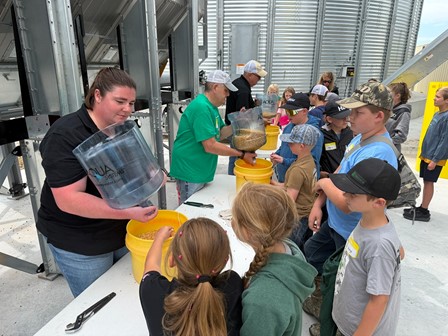
Participants explored the topics of soil science, crop growth stages, drone technology, grain safety and crop diagnostics while learning directly from Purdue Extension educators and agricultural specialists.
The workshop was made possible through the collaboration of Purdue Extension ANR educators, university specialists and industry partners, who each contributed expertise. The program continues to build on the foundation established last year, under the guidance of retired Purdue forage specialist Keith Johnson, whose vision helped launch the workshop.
"The real impact is building relationships and breaking down silos," said regional ANR educator Marty Huseman. "When Extension educators and Purdue specialists work together, they share expertise, strengthen their professional networks and ultimately deliver better, research-based programs for the people we serve."
The workshop also highlighted the importance of engaging the entire family. Parents, guardians and agriculture teachers participated alongside youth throughout the day, including teachers from nearby high schools who attended with seven of their agriculture students. Several families spent the day learning together, reinforcing the workshop's educational experience beyond the youth participants. Jason Adams hosted the group at the Corn and Soybean Innovation Center, providing classroom and meeting space, lunch accommodations and additional facilities when severe weather moved activities indoors.
For Huseman, seeing youth from across Indiana learning together was one of the day's greatest successes.
"Youth don't see county lines or barriers — they come together to learn, make new friends, share experiences and have fun," he said. "That's what made this workshop so special."
By: Extension Communication Committee (Jenny Clark, Olivia De Young, Rachel Dillhoff, Amanda Graupner, Molly Hunt, Kelsey Meyers, Lily Thill)
Teaming up on social media with partner organizations
Joining forces with other Purdue groups, Extension colleagues or partner organizations can create successful programs. Teaming up on social media to promote shared events can increase the chances of program success.
Sometimes, partner organizations may ask if you can help promote one of their events on social media. In these cases, here are some things to consider before sharing:
- Is Purdue Extension an event partner or sponsor?
- Does the content align with Purdue Extension’s mission and values?
- Mission statement:
- Purdue Extension enriches Indiana communities through comprehensive programs in Agriculture and Natural Resources, promoting sustainable practices; Health and Human Sciences, enhancing well-being; Community Development, fostering economic growth; and 4-H and Youth Development, empowering the next generation. We deliver practical, research-based information that enhances lives and livelihoods.
- Does the content align with the clients Extension is trying to serve?
- Is the content accessible (a photo or simple graphic)?
- Is there room in the social media calendar? Would sharing the content take away an opportunity to share about Extension events or services?
Sharing events from partner organizations can strengthen local connections, but each request must be carefully considered. If you have questions about how to best partner with other organizations, please reach out to Rachel Dillhoff (rdillhoff@purdue.edu), Purdue Extension social media coordinator.
Quick tip – Cross-promote events through other mediums
Sharing an event on social media can be a good starting place, but you can amplify your reach through sharing the information through other mediums like email, newsletters, Cascade events, or post-event web stories.
By Rachel Dillhoff, Purdue Extension social media coordinator
As Purdue Extension continues its transition to the regional model, planning is underway for the rollout of regional social media pages. The Communications Committee is developing a coordinated approach to help make the transition as smooth and consistent as possible across the state.
Social media remains a priority because it plays an important role in connecting with local communities, promoting programs and events, and sharing the impact of Purdue Extension. The future social media structure will include both regional Purdue Extension pages and county 4-H pages. Additional information about how the transition will work, along with guidance and resources, will be shared before any changes are implemented.
The goal is to ensure everyone has the information, tools, and support needed to successfully navigate the transition. More updates will be provided as plans are finalized. Please do not make new pages at this time.
By Olivia De Young, communications specialist for Agricultural Communications
As all counties transition into regional teams, so too will web content transition away from using individual county websites as the primary hub for health and human sciences (HHS), agriculture and natural resources (ANR) and community development (CD) programming. Instead, each region will launch a dedicated Regional Teams webpage that reflects the updated Extension structure and showcases regional events, relevant news and shared program offerings across HHS, ANR and CD.
This structure has been tested with the East Central and West Central Regional Teams, and examples of what these pages look like can be found at: https://extension.purdue.edu/region/index.html.
County websites will continue to exist but will be more streamlined, as these three program areas will move to the regional webpages. 4-H youth development will remain housed within county websites at this time.
More information about how educators can support the new regional pages will be shared in the coming months.
Professional Development Conference
By: Steve McKinley, staff development specialist
The 2026 Professional Development Conference (PDC) will be held Wednesday, Dec. 2 and Thursday, Dec. 3, at the Hendricks County 4-H Fairgrounds and Conference Complex in Danville.
PDC SCHEDULE
A draft schedule has been posted to the PDC Website, providing you with an overview of the main events. Details will be added as they become available.
CROOKS and SHARVELLE AWARD NOMINATIONS
Nominations for the Paul B. Crooks Outstanding Educator Award and the Eric G. Sharvelle Outstanding Specialist Award are open now through Oc. 1. Nomination guidelines are available along with a list of previous award winners.
Please consider nominating an outstanding colleague for one of these awards!
COLLABORATION SHOWCASE and RESOURCE FAIR
On Wednesday, Dec. 2, PDC will host a Collaboration Showcase and Resource Fair.
The Collaboration Showcase will highlight collaborations among campus and field-based Extension professionals that provide programs and/or resources to meet community needs in Indiana. Interested teams who would like space to talk about their collaboration can submit the Collaboration Showcase Qualtrics by Aug. 31. Additional information about the Collaboration Showcase is available in this Call for Proposals.
The Resource Fair will include information that campus and field-based Extension professionals can use personally and professionally. If you are interested in participating in the Resource Fair, submit this Qualtrics by Aug. 31. Additional information about the Resource Fair is available in this Call for Proposals.
CONCURENT SESSIONS
Submissions for Concurrent Session will be by invitation only for PDC 2026. The PDC Committee is targeting specific topics and presenters, rather than having a systemwide call for proposals. Our goal is to provide topics that are overarching in nature, able to provide content that all Extension professionals can benefit from personally and professionally, regardless of their specific role with Purdue Extension or their program area.
MISCELLANEOUS
Registration for PDC, along with hotel information, will be available in the coming months. We plan to open registration in mid-September.
Thank you for your interest in PDC 2026!
Purdue Extension Transformation Training - September 22
By: Steve McKinley, staff development specialist
Registration due August 31 via Qualtrics
Purdue Extension Transformation Training | Tuesday, Sept. 22 | 10:00 a.m.-3:30 p.m. EST | Extension field and campus professionals are required to attend this training at one of the following locations:
- Decatur County Fairgrounds — Community Building
- 822 South County Road 200 West, Greensburg
- Huntington County Fairgrounds — Beacon Credit Union Heritage Hall
- 631 E. Taylor St., Huntington
- Martin County 4-H Fairgrounds & Event Center — Community Building
- 2666 U.S. 50, Loogootee
- Tippecanoe County Extension Office
- 1950 S. 18th St., Lafayette
This required training will introduce the Regional Extension Training model and establish a shared foundation for collaboration across teams. Extension staff will explore the structure and purpose of regional programming, focusing on aligning Extension efforts for greater impact. Sessions will emphasize building trust, defining and communicating success within Purdue Extension, and strengthening connections among colleagues. The training will conclude with a collaborative action-planning session to generate ideas for regional programming, partnerships, and communication strategies, which will serve as a foundation for upcoming PDC regional activities and future professional development. Attendance is required to ensure consistent understanding and engagement in regional efforts.
You may choose to attend the training at any of the four identified location. Identical content will be presented at each location by centralized presenters and on-site facilitators.
Registration for this training is available via Qualtrics and is due by Monday, Aug. 31. You will be asked to provide your contact information, select the site you have chosen to attend, and share any special accommodations you need.
The tentative agenda for the Sept. 22 program is available here.
We look forward to working together with you to transform Purdue Extension!
Sincerely,
Purdue Extension Program Leaders
- Henry Quesada, ANR
- Michael Wilcox, CD
- Dani Lay and Jamie Morris, 4-H Youth Development
- Lisa Graves, HHS
Professional Development Opportunity sponsored by ESP
By: Steve McKinley, staff development specialist
The Purdue Alpha Lambda Chapter of Epsilon Sigma Phi (ESP) is pleased to announce the third in a series of three professional development webinars designed to support all Purdue Extension field and campus staff, Purdue Extension support staff and retirees.
Through a grant from National ESP and chapter funds, Monica Kramer McConkey, rural mental health specialist, will present her final webinar, “How to Deal with Change in a Positive Way”. The webinar will be held on Wednesday, Sept. 9, 2-3 p.m. (ET)/1-2 p.m. (CT) via Zoom: https://purdue-edu.zoom.us/j/93904424168
A recording of this webinar will be added to the two previous webinars that are posted on the ESP Website: “Take Care of Yourself” and “Preparing for Change”.
Learn more about Monica in her biography.
An informational flyer about the webinar is available.
The ESP Professional Development committee hopes that you will be able to participate in this final webinar! Questions about the webinar series may be directed to committee chair Lori Bouslog.
Translation Project Reminder
By: Cassandra Salazar, Extension community and staff engagement administrator
To help prevent duplicate translation projects and improve project tracking for our NIFA review, please email all completed translation projects to Cassandra Salazar at salaza14@purdue.edu. Your help with this process ensures we have a record of completed work and helps streamline our reporting efforts. Thank you for your cooperation!
Using Flyers to Their Full Potential
By: Extension Communication Committee (Jenny Clark, Olivia De Young, Rachel Dillhoff, Amanda Graupner, Molly Hunt, Kelsey Meyers, Lily Thill)
Flyers are best suited for print. When shared digitally, flyers that include lots of text present accessibility issues. Here are some tips to help boost engagement and make programs more accessible:
- Do not share flyers via social media. Any text that appears on a social media image is inaccessible to a screen reader, creating communication barriers for people who are blind or visually impaired. Images with accessibility concerns may be suppressed by social media algorithms. Instead, utilize a photograph as your visual element and include pertinent information by listing it in the social media caption or linking to a web page, such as a Cvent listing or event in Cascade.
- Photos of real Extension clientele perform better than stock images. Extensive libraries of photos are available from Ag Comm, National 4-H and Indiana 4-H.
- If you plan to share information via email or on your web page and want a visual element, you can create a simple graphic with just the program name. For example, a graphic could say “MarketReady Producer Training” and then the full program information would be pasted below as text, or HTML.
- You may be able to create an accessible flyer by utilizing accessibility features (tagging, reading order, alternative text for images) when building it. If you do this, export and share the flyer in a format that preserves these features (Accessible PDF). Sometimes this can take a lot of tweaking to make the flyer meet 100% of the ADA requirements. Include all pertinent information in the body of the email or on the webpage.
When preparing to promote a program or opportunity, consider skipping flyer creation entirely. Most of the marketing we do now is digital, and flyers just aren't the best fit. For example, 4-H Round-Up and 4-H Academy serve hundreds of kids, but the flyers for those programs (which we created because we'd always done so) were downloaded fewer than 10 times each last year and were therefore discontinued.
Purdue in the Future
By: Michael Wilcox, assistant director and program leader for community development
I'll never forget the time I was traveling in rural Manitoba, Canada, with Nicole Adams (now a research associate professor at Purdue University's Regenstrief Center for Healthcare), and we stopped for lunch at a small café. When we walked in — I swear you could hear a needle scratch a record — everyone looked up at us. It was a hearty crowd of rural men and women enjoying some “time off,” as it was the middle of February.
Finally, one of them broke the silence, "So, where ya from, eh?" (or something of the sort).
"We are from Purdue University in the United States," I responded.
"Oh, we know Purdue. Great school. We have U of M and USask, but sometimes we have to look to Purdue, Iowa State and other schools for answers."
Perked up with school pride (both Nicole and I are Purdue graduates and employees), we enjoyed our meal and great conversations that ensued.
Fortunately for Purdue University and the people we serve through Purdue Extension, these conversations happen near and far. I've had them under a cotton tree in a remote village in rural Cameroon and at the McDonald's in Winamac, Indiana.
Currently, in Indiana, a conversation about Purdue would very likely focus on the future of Purdue Extension.
Why?
Throughout the United States, land-grant universities are concerned about serving their constituents and the sustainability of their Extension systems. Founded in 1914, the Cooperative Extension System has had countless positive impacts on the individual, household, farm, business, and community levels. But while our tradition is strong, the world we live in now bears little resemblance to that of our great-great-grandparents.
We are at an inflection point.
However, if I were asked to have this conversation right now, I would focus on basketball.
One could argue that Purdue Extension's approach has been reminiscent of man-to-man defense. The hallmarks of this defense are that it assigns each defender a specific opponent to guard, regardless where the ball goes. The biggest advantage is accountability. Every defensive player knows exactly who they're responsible for, which makes it harder for offensive players to get “lost” or find soft spots.
In Extension terms, man-to-man recalls the county-based model, in which Extension educators are assigned to a county and program area(s) (4-H Youth Development, Agriculture and Natural Resources, Community Development, and/or Health and Human Sciences). Every county knows “their” educators, and every educator knows their county, which builds relational trust.
However, this assignment often means the educator must lean toward being a generalist, so they are positioned to assist everyone, from soil health and farm business management at the farm level to food security and financial security at the family level. And if that educator leaves their post, their institutional memory goes with them, creating the need to find a new educator and start the cycle over. As our own Gene Keady showed Boilermaker fans for 25 seasons, man-to-man has many upsides, especially when you have high-quality, dedicated personnel like Purdue Extension has had for over 110 years.
There is another option, one I grew up watching in upstate New York: zone defense. Jim Boeheim of Syracuse University was famous for his 2-3 zone, and, like the knuckleball in baseball, when it is cooking, it cooks. In zone defense, defenders guard areas of the floor rather than specific players. Zone conserves energy, prevents dribble penetration, and can neutralize a team's best individual scorer because no single defender is “assigned” to them. One might say that zone fosters resilience. In Extension terms, zone defense is a regional model that assigns experts to clusters of counties (or regions). To be successful, a zone-like approach requires a strong team in which Extension educators, Extension partners and local/regional leaders communicate and collaborate effectively. Integrated into this approach is the ability to address pressing concerns on a scale where they actually exist, in a region. Today’s challenges, from agriculture to childcare to economic development to civic engagement, don’t fit neatly inside a county line.
Admittedly, zone is not a panacea. If it were, more teams would follow Boeheim's approach. In reality, most teams might favor one but play both. Within Purdue Extension, our program areas exhibit certain inherent tendencies. For example, 4-H Youth Development is deeply tied to local clubs and community identity. Community Development, on the other hand, often operates at municipal, county and regional levels.
We don’t have to imagine this blend. We’re already living it. The Purdue Extension's Succession Planning program, introduced in 2011, embodies the man-to-man approach, as it was initiated by county-based Extension professionals working in close collaboration with campus-based and state-focused Extension specialists at the Purdue Institute for Family Business. It is also man-to-man in that we work directly, often one-on-one, with farm families, family-owned businesses and small businesses through a variety of programs, including Succession Planning, Becoming the Employer of Choice, and Digital Ready Business.
At the same time, the Succession Planning program plays “zone” as training is delivered at the regional level through workshops held across Indiana or online via synchronous webinars, allowing us to scale our efforts so we can reach as many people as possible before focusing on individualized consultations with families and their businesses. Programs like Farm Shield: Protecting Your Legacy, Leaving a Lasting Legacy, and personalized Farm Family Visits all reflect this blend of broad regional reach and targeted, relational support. Resources such as The Farm's Legacy Guidebook (EC-817-W) and the Code Red Plan provide families with practical tools for goal-setting, management transfer and crisis preparedness. And now, given our expertise and success, our “zone” has grown to a national one through Who Will Fill My Shoes: Succession Planning for Land Owners, Farmers, Forest Owners, and Family Businesses, an online program available nationwide, including to the people we serve here in Indiana.
Beyond Extension, these efforts benefit from all three pillars of the land-grant mission. Dr.Maria Marshall and Dr.Renee Wiatt have authored numerous peer-reviewed research papers on succession planning, anchoring our Extension programming in rigorous scholarship. On the teaching side, Dr. Marshall and Dr.Michael Wilcox have mentored graduate and undergraduate students on topics related to small business and economic development, including students such as Karie Taylor and Kyla Wolfe, who are now preparing to attend law school and pursue careers in succession planning. This integration of Extension, research and teaching is what makes the program and the land-grant model so powerful.
Undergoing a transformation of our current scale is not easy. Change rarely is, especially when it touches relationships built over years and the great pride we take in knowing our communities. But no matter the approach, Purdue Extension is committed to delivering practical, research-based information that enhances lives and livelihoods. We are exploring ways to maintain our tangible, effective local presence while fostering a thriving, flexible, interconnected team that leverages strong ties with campus-based and state-focused Extension specialists and the on-the-ground expertise of an agile team of regional educator experts who live, work and play in the region.
This hybrid approach is likely the most sustainable in the long term. Like soil health, we need to recognize that we cannot sacrifice long-term impact for myopic, short-term goals. We cannot keep doing what served our great-great-grandparents and call it service to our great-great-grandchildren. We must work together and focus on the future.
Purdue Extension Podcast
More about our latest Extension updates
News from the directorMore about our latest Extension updates
News from the director