

Popular Landscape Shrub is Invasive
Above: Winged burning bush in a commercial landscape, Leslie J. Mehrhoff, University of Connecticut, Bugwood.org
Beauty is not necessarily an overriding virtue for the winged burning bush (Euonymus alatus). Also called winged euonymus or simply burning bush, it has gorgeous red fall color and has been a popular choice for landscapes since the late 1800s. However, we’ve known since the 1970s that this beautiful plant has demonstrated invasiveness in natural areas.
Purdue experts authored an Extension publication entitled “Invasive Plant Series: Winged Burning Bush.” Much of this article will highlight excerpts from the publication.
“Winged burning bush can tolerate a wide range of sites and soil conditions,” they said. “It grows in full sun and tolerates full shade under a forest canopy.” Its fruits are eaten by birds and dispersed elsewhere, such as from landscapes to neighboring natural areas. It can form dense undergrowth in woodlands.
As the name implies, twigs and branches of this shrub have corky ridges or “wings.” Leaves are arranged oppositely on twigs, from ¾ to 2 inches long, and tapering at each end. “Leaves turn a vibrant red in autumn for plants in full sunlight but may be shades of magenta or pink in shaded areas,” they said. A single plant can produce fertile seed.
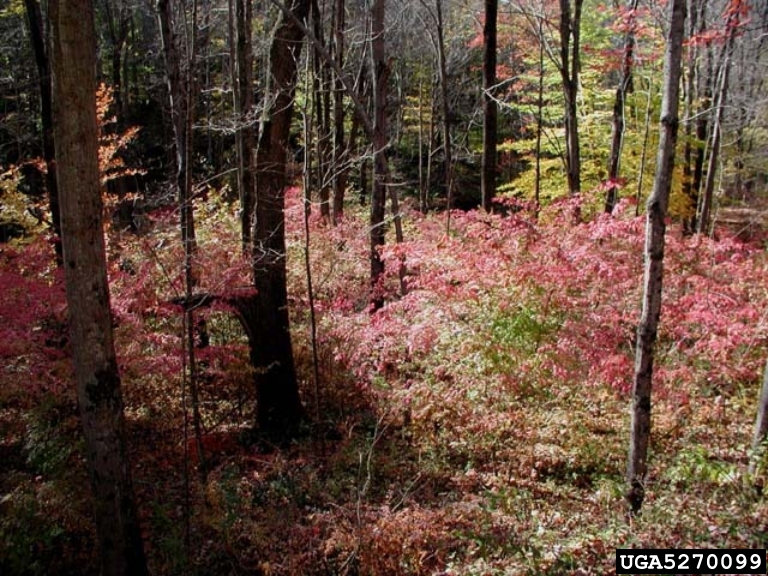
Photo: Winged burning bush dominating a forest understory, Leslie J. Mehrhoff, University of Connecticut, Bugwood.org
Besides this invasive plant, Indiana has three native euonymus species that could be confused with their invasive relative. The most common is eastern burning bush or wahoo (Euonymus atropurpureus), which is a large shrub to the size of a small tree. Running euonymus or running strawberry bush (Euonymus obovatus) is a perennial groundcover that may only get from one foot to a few feet tall. Strawberry bush or brook euonymus (Euonymus americanus) is a small shrub found primarily in southern Indiana.
“The ability of winged burning bush to spread via seeds dispersed by birds, survive and produce seed in shaded environments, and gradually increase density and distribution in forests presents a threat to the native diversity and productivity of natural habitats in Indiana,” they said. “Besides seed production, winged burning bush stands can increase in density by layering, where a branch comes in contact with the soil and roots.” They said research has shown that high deer population levels promote the establishment and spread of some invasive plant species, including winged burning bush. Deer preferentially browse on desirable native plants while avoiding winged burning bush.
The authors urge prevention as the first step in preventing the spread of burning bush. This strategy is simple: don’t plant burning bush.
The authors discuss various control methods for burning bush in natural areas, including manual and mechanical methods, prescribed fire, and chemical controls. See the publication for details. Find it at the Purdue Education Store, https://edustore.purdue.edu.
If you have burning bush in your landscape, please consider removing it and replacing it with a native alternative, like wahoo (previously mentioned), chokeberry, common ninebark, American cranberrybush viburnum, fragrant sumac, or winterberry. Research your potential replacement to ensure it is suited to your landscape location (size, site conditions, etc.).