

Disease May Cause Wilting and Eventual Death of Certain Trees and Shrubs
Above: Sudden wilting and browning of foliage on one side of the tree is typical of Verticillium wilt. (Photo by John Obermeyer in Purdue Extension publication BP-6-W).
This article is not meant to raise an alarm for a new, deadly tree disease. Rather, I wish to increase your awareness of a disease that has been around for a long time. According to Purdue experts, it is one of the most common and destructive diseases of woody ornamental plants in the Midwest.
John Bonkowski, plant disease diagnostician, and Tom Cresswell, director of the Purdue Plant and Pest Diagnostic Laboratory (PPDL), authored the Purdue Extension publication entitled “Verticillium Wilt of Woody Plants.”
The authors describe common and highly susceptible woody hosts of this disease, including redbud, smoketree, tree-of-heaven, maples, rose, lilac, boxwood, and barberry. In addition to woody plants, Verticillium also infects potato, tomato, pepper, eggplant, raspberry, and peppermint. More than 300 plant species have been reported to be susceptible to the disease.
Verticillium wilt is caused by soil-borne fungi in the genus Verticillium. V. dahliae is the most common pathogen encountered in the Midwest, according to the experts. The fungus lives in the soil, and fungal hyphae (microscopic, thread-like filaments that make up the “vegetative” body of fungi) infect plants through the root system of susceptible hosts and invade their water-conducting tissues (xylem). The tree responds by plugging some of the water-conducting vessels with gums and other materials. This restricts water flow in the plant, leading to drought-like symptoms and dieback.
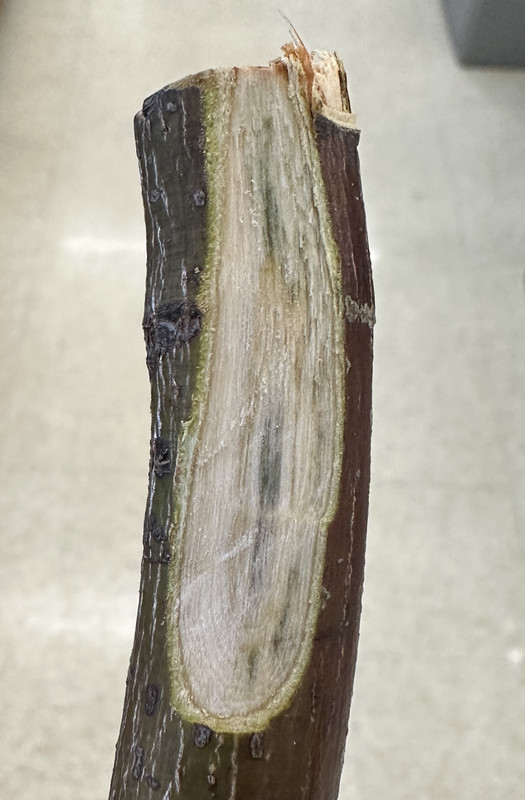
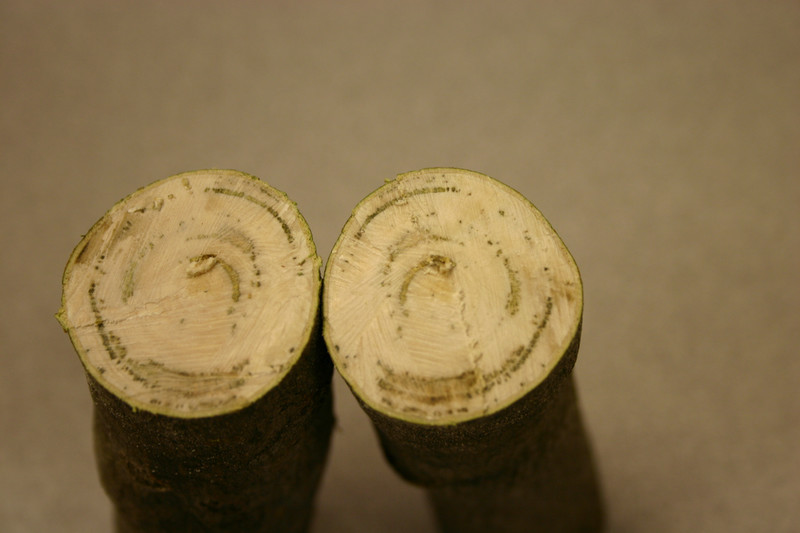
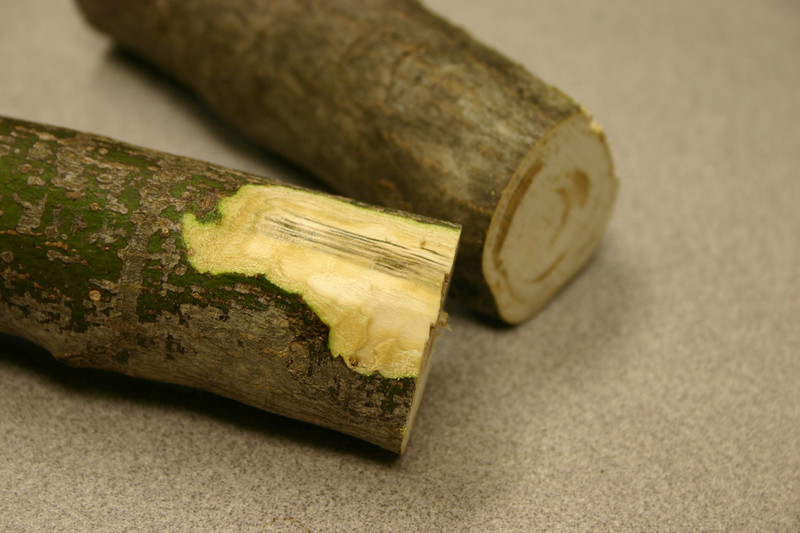
“During midsummer, leaves turn yellow at the margins, then brown and dry,” they said. “Sudden wilting of leaves on one or several branches may occur, which is known as flagging.” They said that frequently, the foliage on only one side of a tree wilts, while the other side remains healthy. The wood under the bark of wilting branches is discolored in streaks following the length of the stem. “The discoloration will vary from bright olive-green (maples) to chocolate-brown (redbud), depending upon the tree species and how long it has been infected.”
“To examine for discolored sapwood, cut into the outer sapwood at the base of branches showing leaf wilt; also examine the outer rings of wood at the cut end of a pruned branch for discoloration,” they said.
“Host susceptibility, site conditions, and environmental conditions influence severity of symptom development,” they said. “Trees under drought, nutrient, or salt stress are more symptomatic.” They said that the speed of decline due to Verticillium wilt will also depend on the tree species. An infected tree may die in a single season or linger on for many seasons, with branch after branch dying and later being invaded by other decay or canker fungi.
So, what can a homeowner do?
“There are no effective fungicide treatments for infected trees,” they said. “Trees or shrubs with mild symptoms can often be maintained for several years by pruning out dead limbs and providing optimal care (appropriate amounts of mulch and fertilizer, and irrigation during dry periods).” Ultimately, most susceptible woody plants decline and die within a few years following first appearance of symptoms.
They said that only Verticillium-resistant trees and shrubs should be planted in landscape sites known to have Verticillium in the soil.
Although Verticillium wilt could affect trees virtually anywhere in Indiana, it is not present in every landscape. In fact, Cresswell said, “We find Verticillium only a few times a year, and it is probably widely scattered all over the state.” So, don’t be too quick to give up on your trees and shrubs, nor immediately assume that a declining tree, such as a maple, has Verticillium wilt.
If you suspect that a plant in your landscape might be suffering from Verticillium wilt, you can send a representative sample and a completed submission form to the Purdue Plant and Pest Diagnostic Laboratory for analysis. Stems should have streaks in the wood to test for Verticillium. Find information at www.ppdl.purdue.edu.
Find a more complete listing of susceptible and resistant plants in the referenced publication, available at Purdue Extension’s Education Store, https://edustore.purdue.edu.
The following images of vascular streaking in Japanese maple from Verticillium wilt were provided by the Purdue Plant and Pest Diagnostic Laboratory (PPDL).
This article was reviewed by John Bonkowski and Tom Cresswell.