

Carpenters of the Insect World
There are carpenters in the insect world, at least in name. Let’s talk about carpenter bees and carpenter ants.
The Purdue Extension publication, E-252-W, “Carpenter Bees,” describes the insects.
Carpenter bees are large insects that closely resemble bumble bees. They are often mistaken for bumble bees, but the most apparent difference is that the carpenter bee has a shiny black abdomen, whereas the bumble bee's is hairy and often yellowish. They are roughly the same size as bumble bees.
Carpenter bees are beneficial native bees, effective as pollinators. They actually cause little serious damage, although continuous tunneling in wood may weaken the structure.
Carpenter bees nest in a wide range of woods. They also choose siding or fascia boards on homes, barns, fences, utility poles, decks, or lawn furniture to bore into, and they can create unsightly damage. Most commonly, carpenter bees select bare, unpainted, and weathered softwoods including redwood, cedar, cypress, and pine. Harder woods and those that are pressure-treated or painted are less attractive to carpenter bees.
Holes are created when the female carpenter bee selects an appropriate site and begins to chew. The nearly perfectly round tunnel entrances are approximately ½ inch in diameter, just large enough for the bee to enter. Tunnels usually consist of an entrance hole that penetrates into the wood ½ to 1 inch across the grain of the wood and then turns at a right angle to follow the wood grain for 6 – 8 inches. After tunneling is completed, the bee will create individual cells using bits of sawdust and frass along the length of the tunnel. The female provisions each cell with a pollen ball into which she will lay an individual egg before sealing it off. Eggs hatch in mid-summer; the larvae feed on the pollen provisions, mature, and emerge as adults in the fall. Fall-emerged bees can either create new holes or enlarge holes made previously in order to pass the winter within them. Only one generation exists per year. Carpenter bees then emerge again in April and May to repeat this cycle.
Carpenter ants are explained in the Purdue Extension publication, E-22-W, “Ants.”
Carpenter ants are large black ants, winged or wingless, and up to one-half inch long. They construct their nests in hollow trees, logs, telephone poles, posts, porch pillars, and other timber used in homes. Their trademark is a small pile of coarse sawdust beneath their nesting site. These nests are typically found in wood with a higher-than-normal moisture content.
Carpenter ants are common and beneficial decomposers of dead and dying trees in woodlands, but they can present structural problems for homeowners.
Carpenter ants hollow out tunnels and discard the sawdust, while termites consume wood. While usually not as serious as termites, they can weaken building structures.
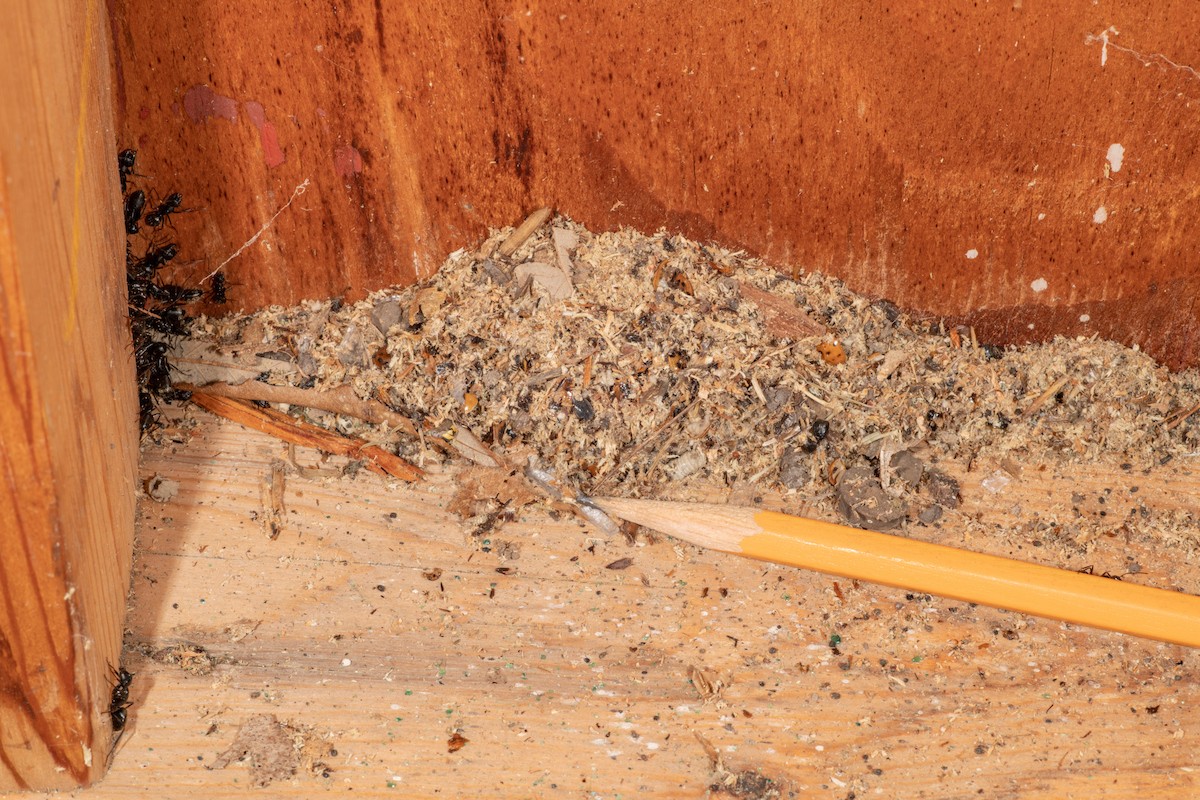
Above: Carpenter ant damage to a shed. Note the excessive sawdust. Picture by John Obermeyer, Purdue University
To prevent carpenter ant invasion, spray foundation walls and adjacent soil with a formulation labeled for this use. Exclude ants by sealing cracks and openings on the exterior of buildings, and by keeping overhanging branches trimmed away from the roofline.
If using an insecticide, follow all label instructions.
Find the above-referenced publications, which include control options, at the Purdue Education Store, https://edustore.purdue.edu.