

Protecting Peaches Against a Common Disease
As we transition from winter to spring, a few peach growers have inquired about protecting their peach trees from a disease they experienced last year – peach leaf curl.
Peach leaf curl has been recognized as a common peach trouble since 1821, and it occurs in almost every region where peaches are grown.
This disease is caused by the fungal pathogen Taphrina deformans. The disease is sometimes called Taphrina leaf curl. Other aliases are curly leaf, curly blight, and leaf blister. It affects peaches and nectarines, which belong to the Prunus genus.
This disease is aptly named, as it causes a puckering and curling of infected leaves. Current peach growers may remember seeing the red, curled, and distorted leaves on their peach trees last year. These symptoms are typically followed by premature leaf drop. Loss of leaves can reduce tree vigor because the tree will use its reserves of carbohydrates to produce a second crop of leaves. It also may affect blossoms, young twigs, and fruit.
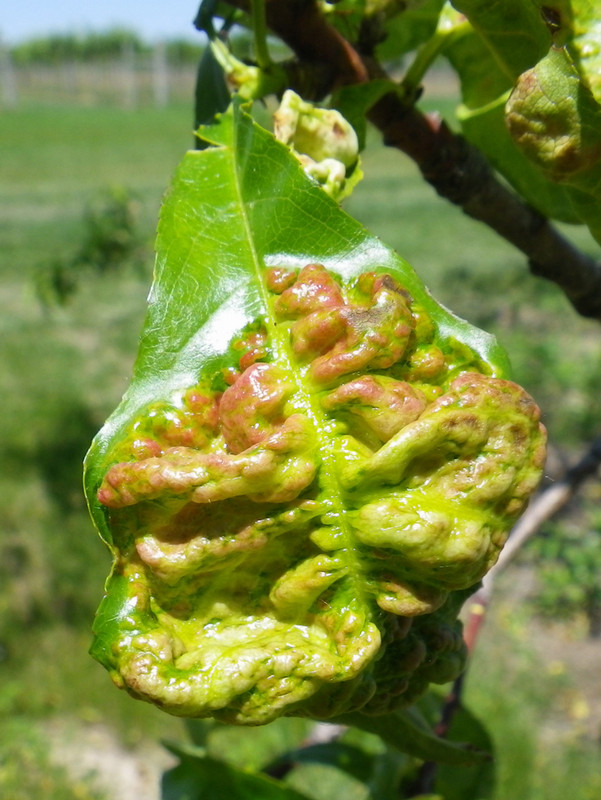
Peach leaf curl tends to be worse in cool, wet springs.
A single, thorough preventive fungicide application is recommended during dormancy. This application could have been applied in late autumn last year after leaf drop, or yet this spring before buds swell. Gail Ruhl, retired senior plant disease diagnostician for Purdue Extension, wrote, “If temperatures in your area have been such that visible bud swell has already occurred in Prunus spp., making it too late for a dormant application of fungicide, then the recommended management for this year is to promote tree vitality through pruning, fertilization, and watering.” If a dormant spray was not applied and the disease develops, the fruit on affected trees should also be thinned to compensate for the loss of leaves.
Liquid lime-sulfur and other labeled fungicides can be used now if bud swell has not yet occurred. So, time is of the essence! If fungal spores are present and buds have begun to swell or open, it is too late to obtain satisfactory control of peach leaf curl, as infection has already occurred. Control is impossible once symptoms are visible.
If lime-sulfur is applied to green foliage, it may cause severe burn.
In addition to the threat of peach leaf curl, peach growers are often frustrated by late spring freezes that kill flower buds, rendering fruit production impossible. At that point, disappointed growers may use the age-old phrase, “Maybe next year.”
For more information, view Ruhl’s original article. For details on the effects of cold weather on peaches and other horticultural plants, search for “Effects of Cold Weather on Horticultural Plants in Indiana” at Purdue Extension’s Education Store.