

Unlocking Nature’s Secret Code
It sounds like the start of a bad joke, but what do a pine cone, a sunflower head, and a pineapple have in common? Your first thought may be an emphatic, “Nothing.” However, they all have a secret code in common – the Fibonacci sequence.
While this may not be the typical “how-to” article for home landscapes, I hope it helps you appreciate an interesting aspect of nature that home gardeners may have seen many times but failed to recognize.
Fibonacci was an Italian mathematician in the 13th century. While the Fibonacci numbers were first described in ancient Indian mathematics, he is credited with popularizing the sequence by describing an idealized rabbit population growth model. We now call it the Fibonacci sequence, which is a set of numbers in which each number is the sum of the two preceding ones. It starts with 0 and 1. 0+1=1, 1+1=2, 2+1=3, 3+2=5, 5+3=8, 8+5=13, and so on. In sequence, they are 0, 1, 1, 2, 3, 5, 8, 13, 21, 34, 55, etc. The sequence Fibonacci discovered appears frequently in nature. When referring to objects in nature, the sequence generally omits 0 and starts with 1, 1, 2, 3, etc.
Graphically, the Fibonacci sequence is represented as a spiral. In nature, we see representations of these spirals, sometimes called Fibonacci spirals or Golden spirals (see below).
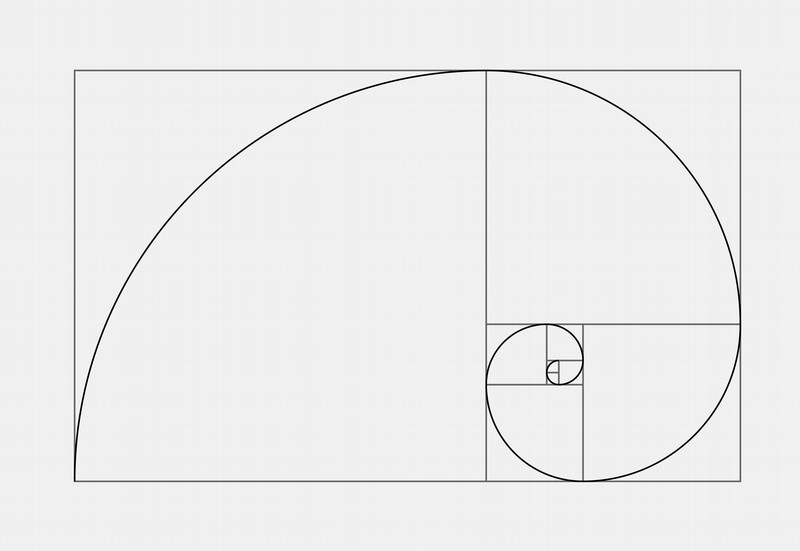
Numbers from the Fibonacci sequence are common in the spirals of pine cone scales, the seeds on a sunflower head, and the individual fruitlets on a pineapple. For example, if you count the spiral rows of seeds clockwise and counter-clockwise on a sunflower head (see banner picture above), starting with the same outside seed, you will usually find a pair of adjacent numbers from the Fibonacci sequence.
Numerous other examples of the Fibonacci spiral can be found in nature. Consider the curve of a chameleon’s tail, the spiraled chambers of a nautilus, or even the spinning image of a galaxy.
Flower petals frequently, but not always, come in numbers that are included in the sequence. Consider that lilies and irises have 3 petals; buttercups, hibiscus, and wild rose have 5 petals; delphiniums have 8 petals; ragwort and corn marigold have 13 petals; Shasta daisies and chicory have 21 petals; and dandelions have 34 petals. Different species within a Genus may vary in petal count, but still exhibit one of the numbers in the Fibonacci sequence. For example, Rudbeckias (coneflowers) commonly have 13, 21, or 34 petals. Asters will have similar variability, typically with 21, 34, or 55 petals.
Purdue University even has a scale model of our solar system in the landscape near the Discovery Learning Research Center called the VOSS (Visiting Our Solar System) Model. It is to scale, in that for every foot you travel around the Fibonacci spiral, you would be traveling approximately 5.4 million miles in space.
Thank you for exploring this aspect of nature with me today. I hope I didn’t cause your mind to spiral out of control.