

Do Trees Explode?
I heard a new term this week, “exploding trees.” After more than 30 years with Purdue Extension, I’ve never heard a Purdue specialist use it. But it’s currently a popular story in the media and on social media. To me, it invokes images of an action movie with your backyard as a war zone, similar to the AI-generated (fake) picture above.
Wisconsin Department of Natural Resources staff were reported as saying that when it gets cold enough, the sap in a tree can turn solid. This leads to a very sudden physical expansion that can sometimes lead to a crack or branches splitting. They added that getting to the level of ‘exploding’ is extremely rare. Okay, that’s Wisconsin. What about Indiana?
Lila Nolan, a writer for Morning Ag Clips, explained exploding trees as probably an over-dramatization of what can happen with trees in cold temperatures, which is frost cracking.
Purdue experts have used the term Southwest injury, implying that the vertical crack that results in the tree is usually on or near the southwest side, the side facing the predominant winter sunlight. This is a condition I have observed multiple times on local trees.
I am writing this article as we are anticipating one of our more severe winter weather events of the season. I’d recommend relaxing about exploding trees. This is not the first year we have experienced sub-zero temperatures, and our trees are generally adapted to our weather patterns.
With that said, let’s talk about the phenomenon of frost cracking, a.k.a. Southwest injury.
Kyle Daniel, Purdue Extension Nursery and Landscape Outreach Specialist, said that Southwest injury occurs during the winter months on the lower section of the trunk on the southwest side. “This happens when there is a sudden temperature drop, for example, the sun going behind a cloud during the winter,” he said. It can also happen as temperatures drop rapidly after the sun goes down.
“Usually this occurs on thin-barked trees, such as Acer spp. [maples], Cercis spp. [redbuds], Malus spp. [apples and crabapples], and others,” he said. “Thick bark trees tend to be more resistant to cracking due to a greater lag in the freeze/thaw cycle.” He added that trees that are under stress due to environmental factors, herbicide injury, and/or insect and disease are more susceptible to cracking.
The Purdue Extension publication, “Effects of Cold Weather on Horticultural Plants in Indiana,” explained frost cracks as occurring when the bark and underlying cambium, usually on the south or southwest side of the tree, heat up on cold, bright days. When the sun sets or is blocked by a cloud, the bark and cambium quickly return to air temperature, which can cause physical and physiological damage. Frost cracks, which are longitudinal splits in the bark, are an example of the physical damage that can occur. The bark and the wood underneath contract at different rates as they cool, causing mechanical stress. Eventually the bark splits, sometimes violently enough to produce a rifle-like noise.
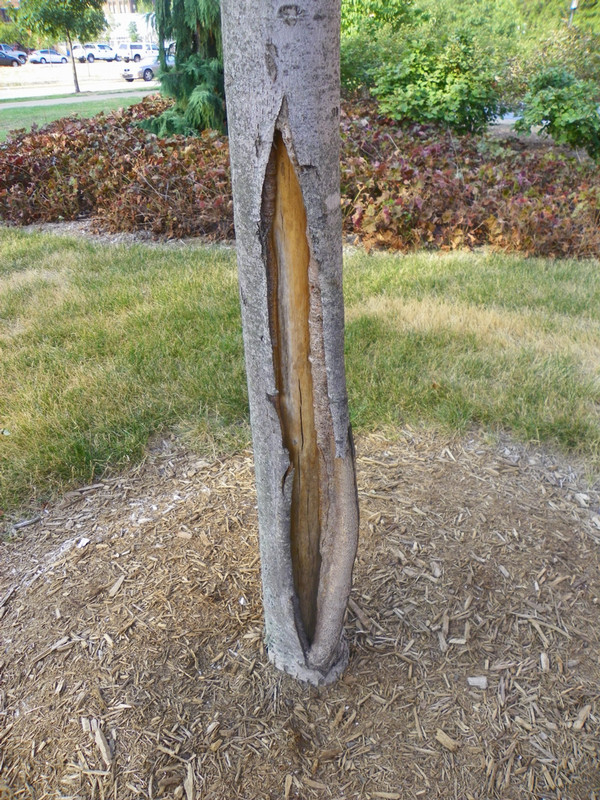
Above: Southwest injury typically causes cracking up the trunk from close to the root flare. This injury may be a few years old now. Photo by Kyle Daniel, Purdue University
Daniel explained it this way, “No matter the initial cause of the crack, the common denominator of a crack in the bark is a pre-set wound. The freeze-thaw cycle during the cold months causes the point of injury to expand and contract. Like with glass, a small point of injury in bark will expand and contract due to sudden heating or cooling, thus causing a large crack.”
“White tree guards may help prevent this from occurring due to the reflection of the sun, preventing overheating on the bottom of the trunk,” he said. “In order to prevent cracking, try to prevent any type of mechanical damage that could cause cracking in the winter.”
Keep in mind that tree guards are preventive measures. In other words, we should have added tree guards or tree wrap in late fall. Then, we should remove it in early spring. Do not leave tree guards or wraps on all year.
Additional research suggests that keeping trees well hydrated (watered) going into winter may also help. University of Minnesota experts said that dry conditions going into the winter can make plant tissues more susceptible to cold damage, especially on evergreens.
Daniel said that in some circumstances, a healthy plant may heal, partitioning off the damaged area, but the bark on a plant under stress, due to drought, herbicide damage, etc., may last the entire life of the tree.
You can access Nolan’s original article, "Can Exploding Trees Really Happen in Winter?" and Daniel’s original article, "Southwest Injury." Find the referenced Purdue Extension publication at Purdue Extension's Education Store.