

Why Do Bees Visit Flowers?
We’re currently dealing with winter conditions, but to warm us up, I thought I’d cover something we observe, but may not fully understand, in spring, summer, and fall: why do bees visit flowers?
Much of my source material today comes from the Purdue Extension publication, “The Complex Life of the Honey Bee,” authored by Fred Whitford et al. (2017). While most of our discussion today will concentrate on honey bees, realize that many other native bees, wasps, flies, beetles, or moths may also pollinate flowers. Additionally, some mammals and birds (especially hummingbirds) aid in pollinating some flowers. Most of these organisms have similar motivations for visiting flowers.
In short, bees visit flowers to collect nutritional items they need, mainly pollen and nectar. Pollen provides protein for the hive. Nectar, which is high in carbohydrates, is used for energy, and the remainder is converted into honey. As bees move around on individual flowers and move from flower to flower, they also help pollinate flowers. Pollination is necessary for fruit production, and pollinators are especially important in the production of fruits, nuts, and some vegetables. So, it’s a “win-win” for bees and plants…and us!
Now that we’ve answered why bees visit flowers, let’s cover what honey bees do with the pollen and nectar, then gain a better understanding of pollination.
Pollen
Pollen from the anther, or male part of the flower, is a colony’s protein source. As bees fly, they become electrostatically charged. As a result, when bees land on a flower, pollen literally “jumps” off the anther and attaches to the hairs on the bee’s body. These hairs are also branched, which helps hold pollen. This adaptation makes collecting pollen easier.
However, bees must still considerably manipulate the plant structure to get enough pollen for a full load. As the bees work the flowers and collect pollen on their bodies, they brush it into a pollen basket (corbicula) found on the outside of her hind legs. Once a bee fills both baskets with pollen, she returns to the hive.
In the hive, pollen is eaten, used as bee bread fed to larvae, or used to produce royal jelly or brood jelly. All larvae are fed royal jelly, a milky fluid rich in protein and lipids, for the first three days, then only a developing queen continues to receive royal jelly. All others receive brood jelly. The queen is fed royal jelly throughout her life.
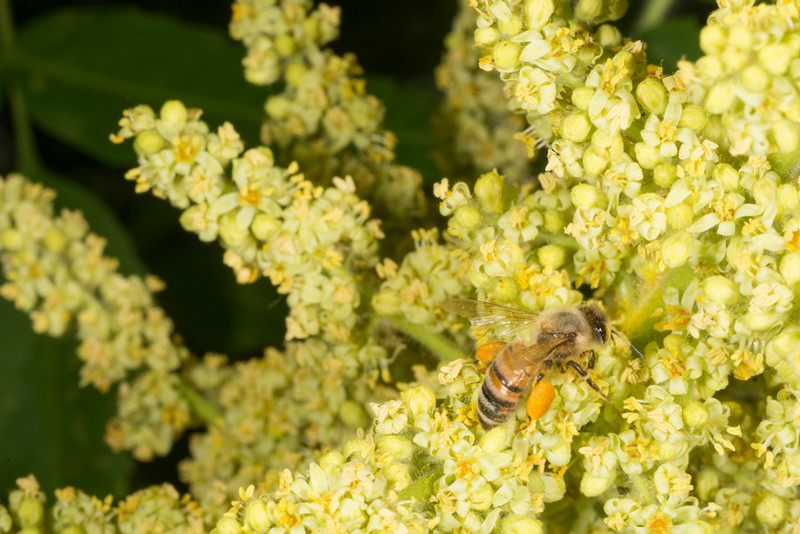
Above: Honey bee on sumac flowers. Note pollen baskets. Photo: Purdue University.
Nectar
The process of converting nectar into honey begins with the foragers.
Foraging bees lap up minute amounts of nectar from flower glands called nectaries, which are located at the base of the female portion of the flower, or from extra-floral parts (depending on plant species). That foraging bee will digest some of the nectar for its own energy needs. Most of the nectar will remain in the bee’s honey stomach, an organ adapted to transport nectar back to the colony for eventual storage. The foraging bee visits flowers until she fills her honey stomach, and then either continues foraging until she has a full load of pollen or simply returns to the hive.
Honey bees use several processes to convert collected nectar into the final product of honey. Enzymes are added to break the complex sugars into the more easily digested sugars, glucose and fructose. They drop nectar into cells in the honeycomb, then dehydrate nectar from 60-80% water to 18% water by fanning their wings to reduce water content. Another enzyme is added to preserve the new honey, then the cells are sealed with wax. It is a complex process.
Pollination
Pollination occurs when pollen is transferred from the male anthers of a flower to the female part called the pistil. Fertilization occurs when the male genetic material from the pollen grains unites with the female ovules in the flower’s ovary (these become seeds). After fertilization, the fruit develops. However, some flowers are self-unfruitful or self-sterile (meaning their own pollen cannot fertilize their ovules). They need cross-pollination from a different variety nearby. For example, a Gala apple tree requires pollen from a different apple variety to produce fruit. In cucurbits, like pumpkins, melons, and squash, vines produce separate male and female flowers, and these flowers can be a few feet apart. Bees are essential for transferring pollen on these types of plants.
To access the above-referenced publication, go to: https://edustore.purdue.edu/.