Rainscaping Education Program

Program Objectives
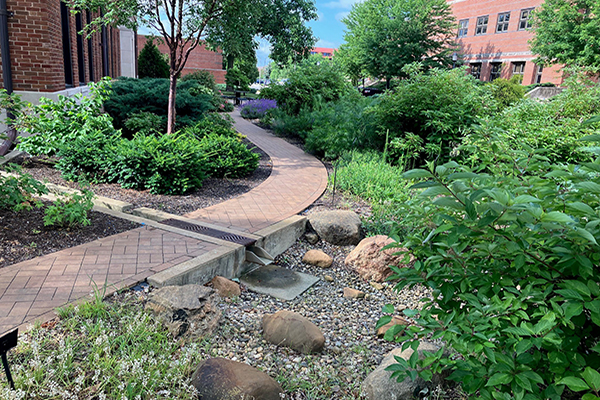
Rainscaping is a combination of sustainable landscape design and management practices that prevents polluted runoff from reaching water bodies — directing stormwater to be absorbed by plants and soils.
The Rainscaping Education Program, in collaboration with Purdue Extension, the University of Illinois Extension, and Illinois-Indiana Sea Grant, provides training and resources on rainscaping practices that can be installed in a residential setting or small-scale public spaces project.
Target Audiences
The program provides advanced training in rain garden planning, installation, and maintenance for:
- Purdue Extension Master Gardeners
- Conservation agencies and organizations
- Stormwater professionals
- Landscape companies and consultants
Participants are encouraged to attend as a community team to support implementation of public education programs and provide technical assistance to homeowners upon completion of the training.
About Rainscaping Education Program
The Purdue Rainscaping Education Program offers state-wide training for Purdue Extension Master Gardeners, conservation agencies and organizations, stormwater professionals and landscape companies and consultants.
The two day workshop sessions cover an introduction to rainscaping and rain gardens with specific modules for rain garden site selection, plant selection and garden design, installation, maintenance and community engagement.
Our program consists of five modules (three hours each) in a workshop setting. Program modules include:
- Flipped classroom instruction
- Online learning opportunities
- Experiential training activities
- Field techniques
- Field trips to community examples of rainscaping projects
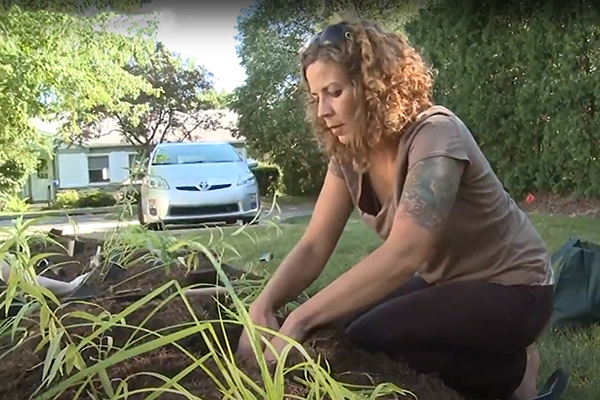
Workshops include hands-on activities, interactive discussions, and field trips to community rainscaping projects. Participants also gain experience through creation of a demonstration rain garden with community partners in a public space.
View a Sample Two-Day Workshop Agenda to Learn More
Program Objectives
Rainscaping is a combination of sustainable landscape design and management practices that prevents polluted runoff from reaching water bodies — directing stormwater to be absorbed by plants and soils.
The Rainscaping Education Program, in collaboration with Purdue Extension, the University of Illinois Extension, and Illinois-Indiana Sea Grant, provides training and resources on rainscaping practices that can be installed in a residential setting or small-scale public spaces project.
Target Audiences
The program provides advanced training in rain garden planning, installation, and maintenance for:
- Purdue Extension Master Gardeners
- Conservation agencies and organizations
- Stormwater professionals
- Landscape companies and consultants
Participants are encouraged to attend as a community team to support implementation of public education programs and provide technical assistance to homeowners upon completion of the training.
About Rainscaping Education Program
The Purdue Rainscaping Education Program offers state-wide training for Purdue Extension Master Gardeners, conservation agencies and organizations, stormwater professionals and landscape companies and consultants.
The two day workshop sessions cover an introduction to rainscaping and rain gardens with specific modules for rain garden site selection, plant selection and garden design, installation, maintenance and community engagement.
Our program consists of five modules (three hours each) in a workshop setting. Program modules include:
- Flipped classroom instruction
- Online learning opportunities
- Experiential training activities
- Field techniques
- Field trips to community examples of rainscaping projects
Workshops include hands-on activities, interactive discussions, and field trips to community rainscaping projects. Participants also gain experience through creation of a demonstration rain garden with community partners in a public space.
View a Sample Two-Day Workshop Agenda to Learn More
What is Rainscaping?
Learn how rainscaping helps manage stormwater while creating healthier, more attractive landscapes.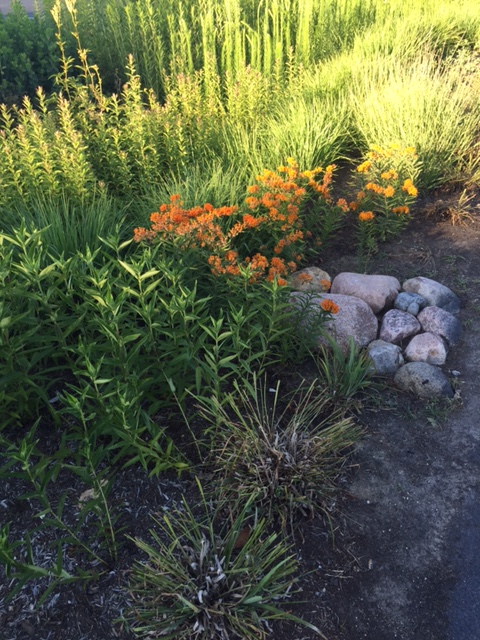 Rainscaping includes the use of sustainable landscape design and management practices at both the household and community scales to prevent polluted runoff from reaching water bodies by directing stormwater to be absorbed by plants and soils. Community water quality potentially affected by homeowner landscape management practices could be improved through increased community education and implementation assistance of rainscaping best management practices.
Rainscaping practices can range from simple solutions to more complex engineered systems and include:
- Installing rain barrels to collect rainwater to irrigate landscapes
- Constructing bioretention areas such as bioswales and rain gardens
- Disconnecting downspouts from storm sewers and redirecting into lawns or gardens
- Maintaining and protecting existing trees and shrubs and other natural features
- Selecting appropriate plants – the right plant for the right place
- Reducing impervious surfaces through installing brick pavers, pervious concrete, or gravel in place of traditional concrete or asphalt
- Planting buffer strips around water bodies
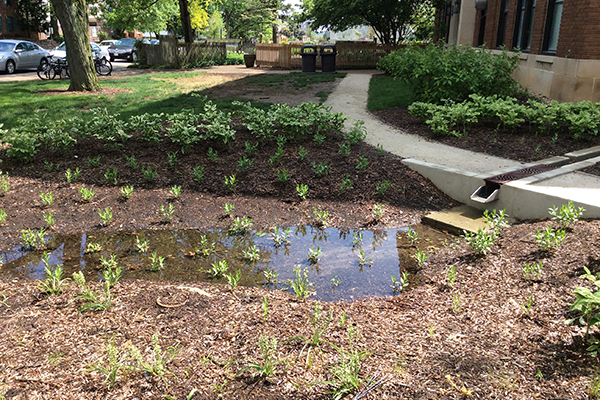
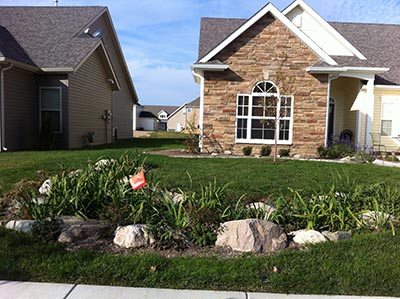 A rain garden is a type of bioretention, constructed as a shallow depression to hold and infiltrate water from rooftops via downspouts, driveways or other impervious surfaces to reduce polluted rainwater runoff.
Sizes and depths vary based on the amount of impervious surfaces and soil types, but typical residential rain garden sizes are 100-300 square feet and 4-8 inches deep.
Rain gardens are planted with native or well adapted plant species that can tolerate both wet and dry conditions and have deep roots that promote water infiltration. Water should drain completely within 24-48 hours.
Specific maintenance considerations include watering plants until well established in the first two years, annual weeding and mulching, and removing debris as needed from blocking water flow.
Rain gardens can be designed in a variety of ways to meet individual preferences as a landscaping feature for seasonal interest, wildlife habitat, color, and function.
Videos:
Rain Garden Installation Part 1
Rain Garden Installation Part 2
Collecting rainwater using rain barrels or other vessels is an ancient practice still used today. Rain barrels are an easy way to collect rainwater from your roof that can then be used to water your landscaping and gardens to save money on your water bill and provide water during drought times. Environmentally, rain barrels collect water that would ordinarily flow across your lawn picking up pesticides, sediment, and nutrients and carrying them to the local storm drains, then ultimately to rivers and streams. Rain barrels can often be purchased locally, or you can easily make your own.
Video:
Rain Barrel Installation
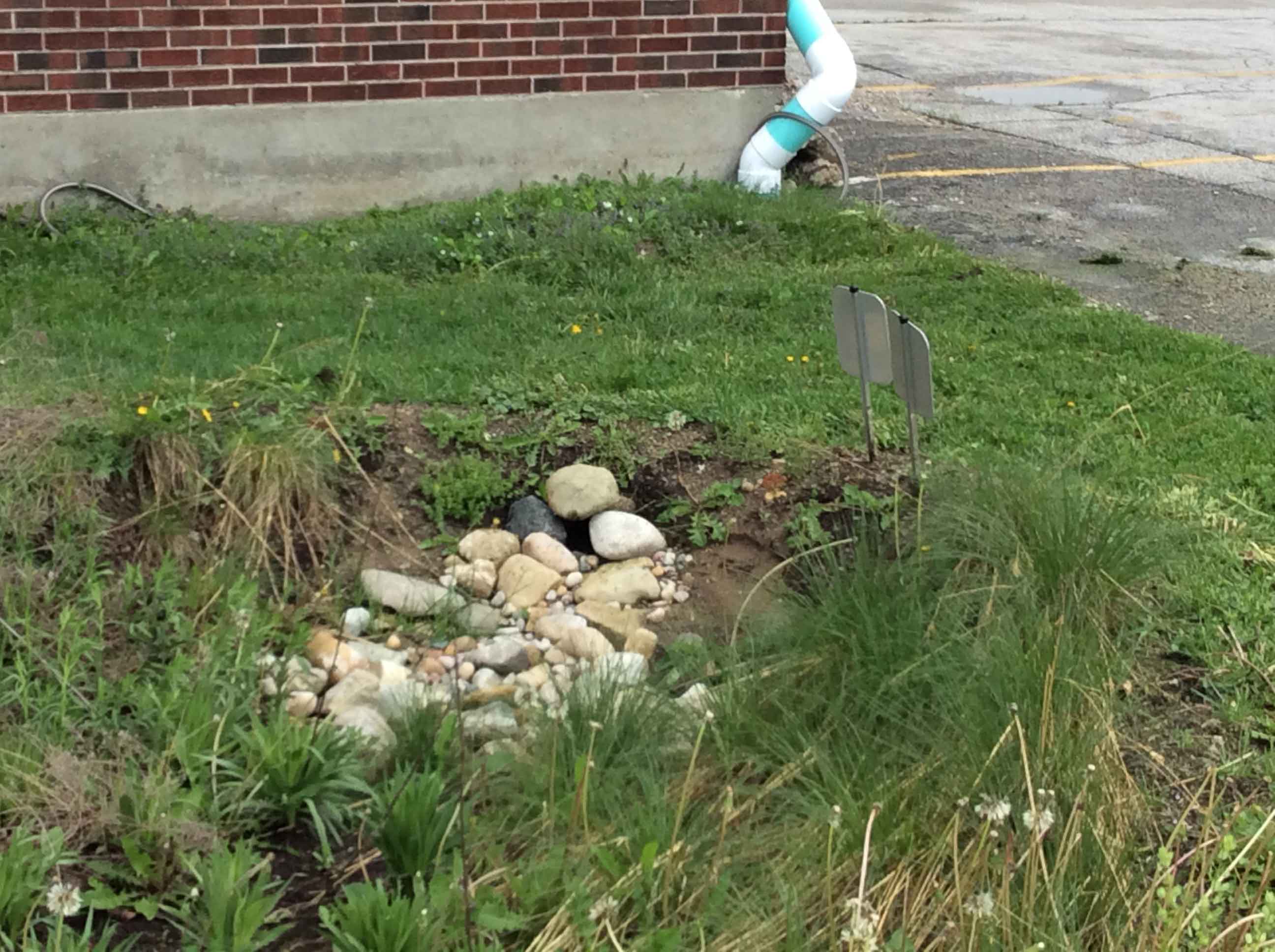 Gutters and downspouts can be redirected from draining roof runoff directly onto paved surfaces or into storm water systems or ditches to reduce runoff from the property while also reducing on-site irrigation. Water from downspouts can be redirected to drain and soak into existing lawn or landscaping, porous pavement, a rain garden, swale, or rain barrels for storage and reuse. This inexpensive rainscaping practice can be accomplished through adding an elbow and extensions to the downspout with a splash guard placed to direct water away from foundations and toward the desired discharge location. Maintain the practice by removing leaves and debris from gutters and downspouts and checking for leaks or erosion.
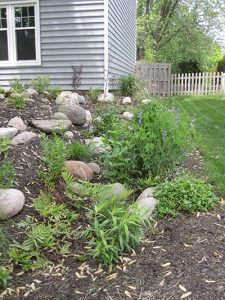 Homeowners often select native plants to grow in their rain gardens. Indiana native plant species are commonly grown in rain gardens because of their adaptation to the local climate, soils, and many species exhibit drought tolerance and disease resistance. Many native plant species attract wildlife by providing nectar, food, and shelter. Likewise, native prairie species tend to have profound and extensive root systems making them excellent choices for rain gardens. These deep root systems allow for infiltration and percolation of water moving through the soil. The deep roots help these plants survive the hot Indiana summers and create root channels that help water drain from the rain garden. Although, native plants are usually recommended for use in rain gardens, homeowners are not limited to just native plant species. Non-native horticultural plant species will grow well in rain gardens. Regardless of whether native or non-native plants are chosen, homeowners should consider the following factors when selecting plants for a rain garden:
- Moisture tolerance
- Light requirement
- Plant size and growth habit
- Plant growth rate (Don’t choose invasive plants)
- Seasonal interest
- Salt tolerance
- Selections for wildlife habitat
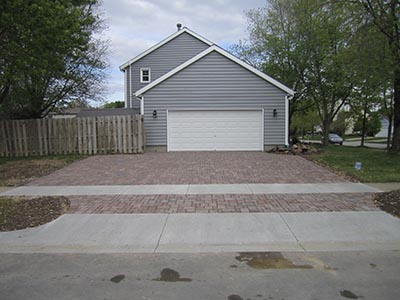 Impervious surfaces such as driveways, roads, parking lots, patios, and walkways do not allow rainwater to pass through the substrate into the ground. Instead, they cause rain water to run off at an increased speed, causing increased erosion, picking up pollutants (pesticides, sediment, and nutrients), and carrying them to the storm drains, then ultimately to rivers and streams. These surfaces can be replaced with pervious options including brick pavers, pervious concrete, turf stones, or gravel. These options allow polluted rainwater to move through these surfaces and into the soil where it naturally filters the water before returning to the groundwater.
Rainscaping Interest Form
Complete this form to receive information about future Rainscaping workshops hosted by Purdue Extension.
Interested in Workshops


Working With Our Partners